In the fall of 2024, members of Williams Lake First Nation (WLFN) took significant strides toward strengthening their community’s emergency response capabilities through hands-on wildfire and emergency management training. Dave Altrows, from Community Based Solutions, delivered a series of essential courses: a Chainsaw Safety course, S-230 Single Resource Leader/Introduction to Supervision, S-241 Fire Assessment, and ICS-200, each providing a strong foundation in wildfire preparedness and response.
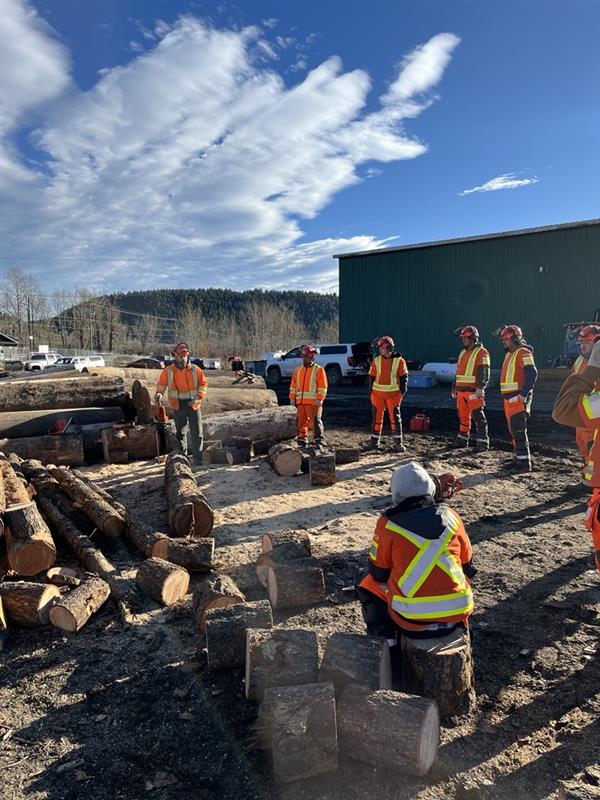
The Chainsaw Safety course was a highlight, combining practical skills with a focus on safe operation. Ryan Lewis, a seasoned wildfire specialist and hand faller who observed the training, emphasized the importance of hands-on learning in building participant confidence and competence.
“Chainsaw training offers fundamental skills, whether used for gathering firewood for the community or building experience toward becoming a professional faller,” Lewis noted. “Chainsaw operation is critical on nearly all wildfires, but these skills extend beyond firefighting and can open doors in various fields.”
Participants engaged in the S-230 Single Resource Leader/Introduction to Supervision course following the Chainsaw Safety course. This training introduces potential crew leaders to the Single Resource Leader (SRL) role within the Incident Command System (ICS). It focuses on developing leadership skills needed to manage personnel on active wildfires.
“The S-230 is a great course for those moving into leadership roles,” explained Lewis. “It provides them with the knowledge and confidence to supervise others safely and effectively, which is crucial for successful Fireline operations.”
Participants next dove into the S-241 Fire Assessment, designed to help students learn how to accurately “size up” a wildfire. As a former Initial Attack Crew Leader, Lewis highlighted how crucial accurate fire assessment is for initial response success.
“Community members who can ‘paint a clear picture’ of the fire’s access, water sources, size/intensity, terrain features, etc… set responders up for a safer, more effective containment effort,” he remarked.
The course trains participants to communicate essential details that can expedite safe and strategic responses, even if they aren’t on the Fireline.
The training concluded with ICS-200, a basic course on the Incident Command System. This system, used across various emergency scenarios, from wildfires to floods, enables coordinated and organized response efforts. Students are left with a foundational knowledge of their potential roles within an incident command structure, a skill set valuable for supporting emergency response at any level.
Altogether, these courses provided WLFN participants with essential, transferable skills, strengthening the community’s overall resilience. As Lewis summed up,
“This training represents one of the most enjoyable yet valuable parts of our Wildfire Training Program, offering practical skills and potential employment pathways to benefit the community.”


 News
News Library
 Videos